


Picture this: a cloud bank rolls in over your neighborhood at 2 PM tomorrow, and your solar system already knows. It charged your battery a little extra overnight, just in case. By the time the sky actually darkens, your home barely notices the dip.
That’s not science fiction anymore. It’s what AI-driven home energy management systems are doing right now, in real houses, using inverters that have quietly turned into weather forecasters and electricity traders.
For most of solar power’s history, your inverter had one job: convert the DC electricity your panels make into the AC electricity your appliances use. It didn’t think. It didn’t plan. It just converted.
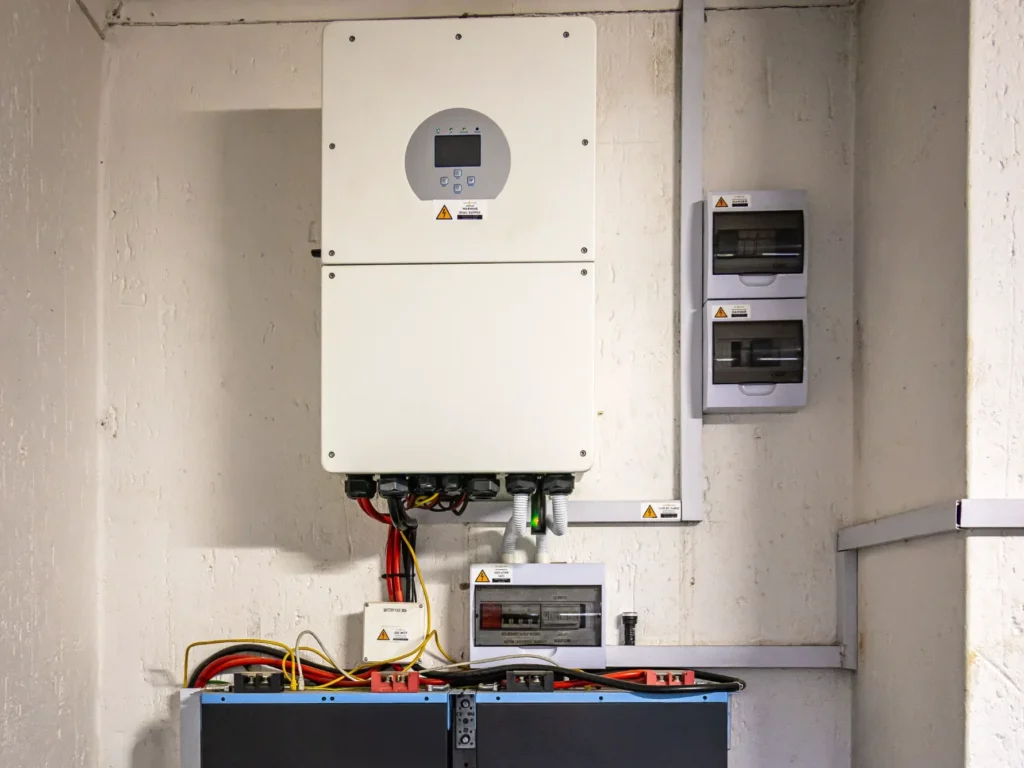
That’s changed. A modern smart inverter pulls in weather data, watches your household’s usage patterns, and checks real-time electricity prices then decides, on its own, when to charge your battery, when to draw from the grid, and when to sell power back. It’s less like a converter now and more like a quiet financial manager living in your garage.
Table of Contents
What “AI-Driven Home Energy Management” Actually Means
Let’s strip away the marketing language for a second. A home energy management system, or HEMS, is software that coordinates your solar panels, battery, inverter, and major appliances so they work together instead of independently.
Add AI to that, and the system stops just reacting. It starts predicting.
Here’s the practical difference. A non-AI system might say: “battery is low, charge it now.” An AI-driven system says: “tomorrow’s forecast shows clouds until noon, electricity prices spike at 5 PM, and your historical usage shows you’ll need extra power for dinner, so charge fully overnight while rates are cheapest.”
That shift from reactive to predictive is the whole story.
How Smart Inverters Actually Predict the Weather
Your inverter isn’t running its own weather satellite. It’s pulling forecast data from weather APIs, often refreshed every 15 minutes, and combining that with machine learning models trained on historical solar output.
Meteomatics, one of the firms supplying this kind of forecasting data to energy companies, developed a hybrid approach that blends physics-based weather modeling with machine learning trained on actual power output not just theoretical “ideal” conditions. That combination improved forecast accuracy by 13% for solar and up to 50% for wind, with real financial savings for the operators using it.
Why does that matter to you specifically? Because the more accurately your system can predict tomorrow’s sunlight, the better it can decide tonight whether to top off your battery from the grid or wait for free solar in the morning.
Why 15-Minute Forecast Updates Matter More Than You’d Think
A forecast that updates once a day is almost useless for a battery making charge-or-discharge decisions hour by hour. Weather shifts. Cloud cover moves faster than daily forecasts can track.
That’s why the better residential systems now pull updated data every 15 minutes instead of once in the morning. It’s a small technical detail with a real-world payoff: fewer wasted charging cycles, and less chance of your battery being empty right when a cloud bank rolls through at exactly the wrong hour.
The Electricity Trading Part Where the Real Savings Show Up
Here’s where things get interesting for your wallet. Most U.S. homeowners still pay a flat rate for electricity, no matter what time they use it. But a growing number are on time-of-use (TOU) plans, where prices swing depending on the hour.
In Arizona, for example, APS’s Saver Choice Plus rate charges roughly $0.1235 per kWh off-peak and $0.3439 per kWh during peak hours, a spread of about $0.22 per kWh that adds up to $600 to $800 a year for a 13.5 kWh battery doing nothing more than charging cheap and discharging expensive.
That’s the “trading” part of AI-driven home energy management. Your system charges the battery when power is cheapest often overnight or during peak midday solar and discharges it during the expensive evening window, automatically, without you lifting a finger.
In states with stacked incentive programs, the math gets even better. Massachusetts, Connecticut, Rhode Island, and Vermont homeowners enrolled in the ConnectedSolutions program can stack $1,650 to $1,950 a year in demand-response revenue on top of standard time-of-use arbitrage savings of $300 to $700 a year.
Virtual Power Plants: Getting Paid, Not Just Saving
This is the part most homeowners haven’t heard about yet. A virtual power plant, or VPP, is a network of home batteries that a utility can call on collectively during periods of high demand instead of firing up an expensive backup power plant.
The U.S. Department of Energy estimates that tripling current VPP capacity to 80–160 gigawatts by 2030 could cover 10 to 20 percent of U.S. peak electricity load and save roughly $10 billion a year in avoided grid infrastructure costs.
For you, that translates into real payments. In Arizona, APS’s VPP program pays homeowners over $500 a year for letting the utility briefly tap their battery during grid stress events. In Vermont, Green Mountain Power runs one of the more aggressive programs, with grid services payments of roughly $150 per kW in summer and $50 per kW in winter for participating customers.
Illinois homeowners will soon have a similar option. Under the Clean and Reliable Grid Affordability Act signed by Governor Pritzker in January 2026, ComEd is required to launch a formal VPP program, expected by June 30, 2026. Enrollment requires switching to ComEd’s hourly pricing rate, but the combination of an upfront battery rebate plus ongoing VPP payments meaningfully changes the financial picture for homeowners who already have solar.
What This Actually Costs You in 2026
Let’s be honest about the price tag, because this isn’t cheap, and the math has shifted recently.
A 13.5 kWh home battery, the size of a single Tesla Powerwall 3 runs about $15,300 to $16,200 fully installed in 2026. That’s a noticeable jump from where prices sat just a year or two earlier, partly because the federal 30% Residential Clean Energy Credit no longer applies to battery systems placed in service after December 31, 2025.
That changes the payback timeline. Without solar or favorable time-of-use rates, a standalone battery can take more than 15 years to pay for itself. With solar, time-of-use rates, and a VPP program stacked together, payback often lands in the 7-to-10-year range instead.
| Scenario | Typical Annual Value | Payback Period (Approx.) |
| Battery only, flat-rate utility, no VPP | $200–$500/year | 15+ years |
| Battery + solar + time-of-use rates | $300–$700/year | 8–10 years |
| Battery + solar + TOU + VPP program (e.g., MA ConnectedSolutions) | $2,000–$2,600/year | 5–7 years |
| Battery + solar + TOU + VPP (e.g., AZ APS program) | $1,100–$1,500/year | 6–9 years |
Read our guide to 10 Home Upgrades that Cuts Electricity Bills in 2026
That table isn’t theoretical it’s built from real utility tariff filings and program documentation across multiple states, so your actual numbers will depend heavily on where you live and which programs your utility offers.
Is This Actually Worth It for Your Home?
Honestly? It depends more on your utility than on the technology itself.
If your utility still offers generous net metering, your outages are rare, and you’re not on a time-of-use plan, an AI-driven smart inverter setup is a nice-to-have, not a financial slam dunk. The software is only as valuable as the price signals it has to work with.
But if you’re in a state with real time-of-use pricing, an active VPP program, or both. Arizona, California, Massachusetts, Illinois, and a growing list of others, this is where the economics genuinely shift in your favor. The AI isn’t doing anything magical. It’s just making faster, more consistent decisions than you would manually, every single day, without you having to track electricity prices yourself.
One honest caveat worth saying out loud: older electrical panels sometimes need a $2,000 to $4,000 upgrade before a battery system can even be installed. That’s a cost a lot of online calculators conveniently leave out.
Frequently Asked Questions
It’s software that uses artificial intelligence to coordinate your solar panels, battery, and inverter automatically predicting weather, household usage, and electricity prices to decide when to charge, discharge, or draw from the grid, without you managing it manually.
No. A battery can charge directly from the grid and still help you save through time-of-use arbitrage. But solar adds a free daytime charging source, which generally improves the financial case significantly.
A typical 13.5 kWh battery system costs roughly $15,000 to $16,200 fully installed, though smaller or budget systems (including newer sodium-ion options) can run lower, around $8,500 to $13,000 for a 10 kWh system.
No. As of systems placed in service after December 31, 2025, the 30% federal Residential Clean Energy Credit no longer applies to new battery installations, according to IRS guidance.
A VPP is a network of home batteries a utility can tap collectively during peak demand. You enroll through your utility or an approved aggregator, agree to share a portion of your stored power during defined dispatch windows, and receive payments typically $500 to $1,500+ a year depending on your state and program.
Reasonably well. Systems using hybrid physics-and-machine-learning forecasting models have shown solar forecast accuracy improvements of around 13%, refreshed as often as every 15 minutes enough to meaningfully improve charging decisions, though not perfect.
Arizona (APS), California (SGIP, multiple utility VPPs), Massachusetts and the broader ConnectedSolutions states (CT, RI, VT), and Illinois (ComEd’s new program launching mid-2026) currently offer some of the strongest combinations of incentives and time-of-use rates.
The Bottom Line
AI-driven home energy management isn’t a futuristic concept anymore, it’s quietly running in garages and utility rooms across the country right now, turning ordinary inverters into weather-watching, price-trading decision makers. The technology works. The real question isn’t whether it’s smart enough; it’s whether your local utility’s rate structure and incentive programs make it worth the investment for your specific home. Check your utility’s time-of-use rates and VPP availability before you assume the math works the same way it does for your neighbor three states over.
SOURCES
- Meteomatics — “AI Method Enhances Solar and Wind Power Forecasts” (2026)
- Home Energy Basics — “Are Home Batteries Worth It in 2026?” (2026)
- Avepower — “Home Battery Storage in 2026: Costs, Sizes, Incentives Guide” (2026)
- U.S. Department of Energy — “Virtual Power Plants Projects” (energy.gov)“
- AZ Energy Hub — “APS Virtual Power Plant 2026: Earn $500+/Year from Battery” (2026)
- Red Star Electric — “Virtual Power Plants: Make ComEd’s New Program Work for You” (2026)
- NuWatt Energy — “TOU + Battery Strategy Guide 2026” (2026)