
You check your solar app, and the numbers look a little low this month. Not broken. Not an error message. Just… quietly underperforming.
Most homeowners never think twice about it. But here’s the uncomfortable truth: dirty solar panels increase electric bill costs in a way that’s easy to miss because nothing looks wrong from the ground.
There’s no warning light for dirt. No alert that says “hey, that layer of pollen on your roof is costing you real money.” It just shows up months later as a slightly higher bill and a slightly lower solar credit, and most people never connect the two.
Here are five facts that explain exactly how much that grime is actually costing you and when it’s worth doing something about it.
Table of Contents
Fact 1: The Efficiency Loss Range Is Wider Than You’d Guess
Ask five different solar companies how much dirt affects output, and you’ll get five different answers. That’s not because anyone’s lying it’s because the real range genuinely is wide.
Field reports and studies show dirty solar panels can lose anywhere from 5% to 30% of their output, with the higher end showing up mostly in dry, dusty regions or areas with heavy air pollution. Research cited from the National Renewable Energy Laboratory puts soiling losses in a similarly broad range roughly 1.5% up to over 25%, depending on your location, local air quality, and how long it’s been since your last cleaning.
That’s the honest answer: it depends heavily on where you live. A home in coastal Oregon with regular rain is in a completely different situation than a home in dusty inland California.
Why the Range Is So Wide
Rain helps, but it doesn’t fully clean panels the way most people assume. It rinses off loose dust, similar to how rain doesn’t fully clean a car windshield it can actually leave behind streaks and mineral deposits that block light just as effectively as the dirt did.
That’s why two homes with identical solar systems, ten miles apart, can have completely different soiling losses depending on local dust, pollen, and rainfall patterns.
Fact 2: Pollen Season Hits Harder Than Most Homeowners Expect
If you live somewhere with a real spring pollen season, this fact matters more than any other on this list.
A field study across five solar installations in North Carolina found that pollen alone cut production by up to 15% at its peak and rainfall failed to restore the panels back to their fully cleaned baseline afterward. That’s a meaningful chunk of your annual production disappearing during just a few weeks of the year.
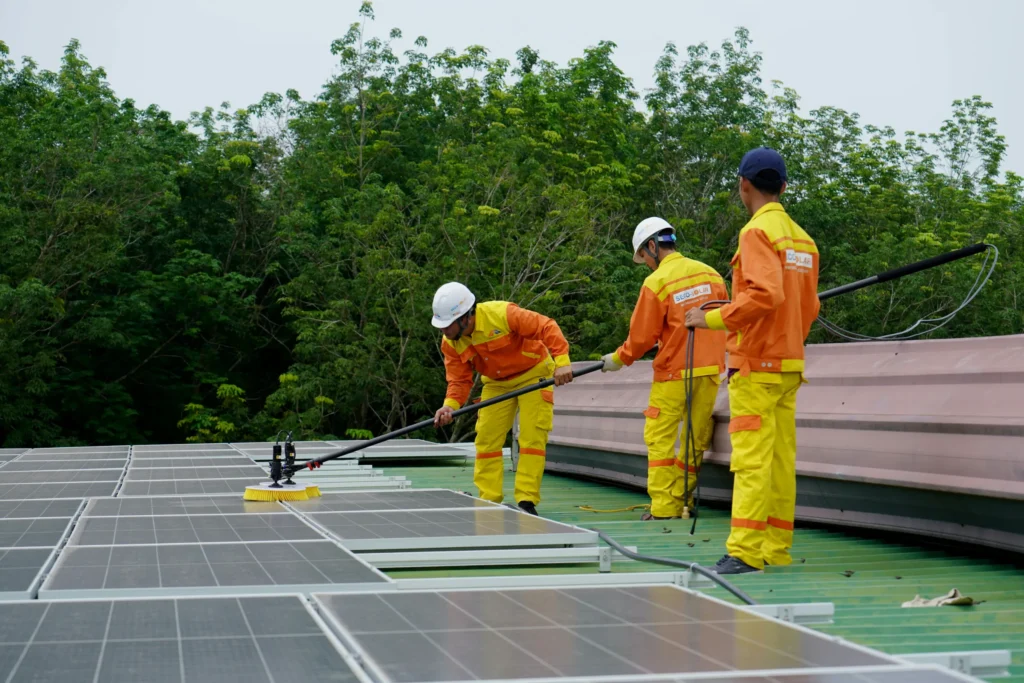
Top 4 Safest Ways to Clean Rooftop Solar Panels
If you’ve ever noticed a yellow-green film on your car during pollen season, your roof panels are catching the exact same layer just somewhere you don’t look every day.
Fact 3: The Dollar Cost Adds Up Faster in High-Electricity States
Here’s where the “shocking” part actually becomes concrete instead of abstract.
On a California home generating roughly $1,800 a year in solar savings, a modest 7% soiling loss costs about $125 a year. Push that to the 15% loss level measured in the North Carolina pollen study, and you’re looking at closer to $270 a year for panels that still look basically fine from the driveway.
That math changes depending on your local electricity rate. Professional cleaning tends to pay for itself fastest in high-rate states. California, where rates commonly run $0.30+/kWh, or Hawaii, where they can exceed $0.35/kWh, because every kWh of restored production is worth more there than it would be in a cheaper-electricity state.
A Simple Way to Check Your Own Loss
You don’t need to guess. Pull your inverter’s monthly output data and compare it against the same month last year, or against your system’s original projected output. A gap of 10% or more that isn’t explained by weather or new shade (a tree that’s grown taller, for example) is usually a soiling issue, not a system problem.
Fact 4: Professional Cleaning Costs Less Than Most People Assume
A lot of homeowners skip cleaning because they assume it’s an expensive hassle. In 2026, professional solar panel cleaning typically runs $150 to $500 per visit nationally, with most single-story homes landing in the $200–$350 range.
Annual maintenance plans covering two cleanings a year usually run $390 to $720, and often save 10–20% compared to booking single visits separately.
| Cleaning Approach | Typical Annual Cost | Best For |
| DIY (soft brush, filtered water) | Under $50/year after initial supplies | Single-story, easily accessible roofs |
| Professional, single annual visit | $200–$350 | Most standard residential systems |
| Professional, twice-yearly contract | $390–$720 | High-soiling regions (dust, pollen, coastal) |
In high-soiling markets, a $250–$350 professional cleaning typically pays for itself within the year through restored production alone before even counting the convenience or safety of not climbing on your own roof.
When DIY Actually Makes Sense
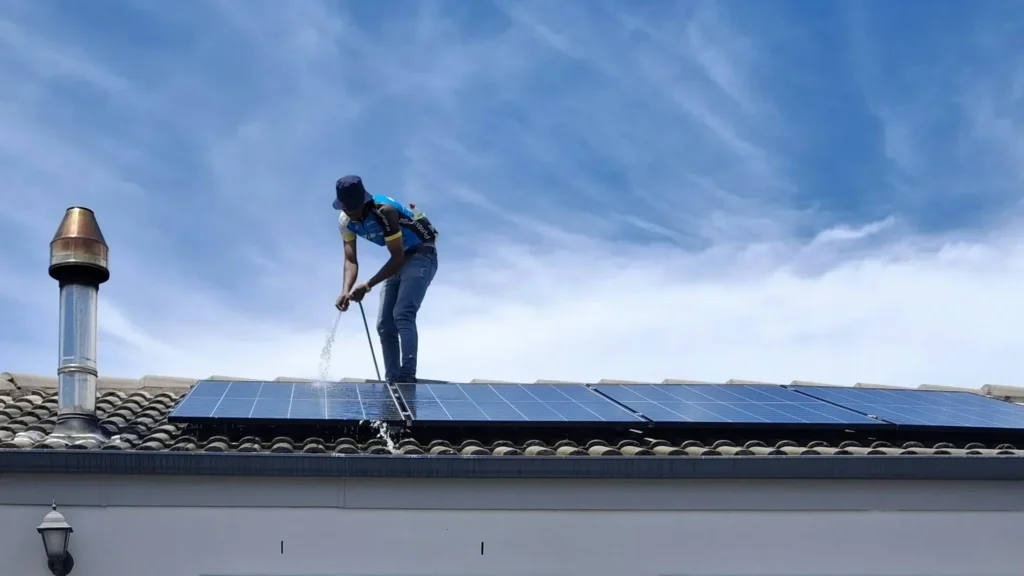
If your system is ground-mounted or on an easily accessible single-story roof, DIY cleaning with a soft, non-abrasive brush and plain or filtered water can save real money over time. But steep roofs, two-story homes, or systems over 25 panels are generally safer left to a professional the fall risk isn’t worth the savings.
Fact 5: Not All “Dirt” Is Equal And Some of It You Can’t Rinse Off
This is the fact most homeowners get wrong. They assume rain solves the problem. It doesn’t, at least not fully.
Hard water and mineral-heavy tap water can leave spot residue that’s arguably worse than the original dust, because it bonds to the glass instead of just sitting on top of it. In regions with hard water Arizona is a commonly cited example professional cleaners use deionized water systems specifically to avoid this problem, since a garden hose rinse in those areas can make panels look clean while actually leaving a light-blocking mineral film behind.
Bird droppings and wildfire ash are the other two categories that rain genuinely struggles with. Both tend to bake onto the glass surface, especially in warmer climates, and typically need an actual cleaning rather than waiting for the next storm.
Is Cleaning Actually Worth It for Your Home?
Honestly, it depends on three things: your local climate, your electricity rate, and how long it’s been since your last cleaning.
If you live somewhere with regular rain, moderate electricity rates, and no major nearby dust or pollen source, you may only need cleaning once every year or two and DIY might be all you ever need. If you’re in a dry, dusty, high-pollen, or high-electricity-rate area, the math shifts quickly in favor of a twice-yearly professional schedule.
One honest caveat: manufacturer warranties almost never require professional cleaning, but they do typically exclude damage from improper cleaning pressure washers, abrasive pads, or harsh chemicals can void coverage on a system that likely cost well over $15,000 to install. That’s worth knowing before you or anyone you hire reaches for the wrong tool.
FAQs About Dirty Solar Panels and Electric Bills
Yes. Dirt and debris block sunlight from reaching the solar cells, which reduces energy output. That lost production means your system generates less free electricity, so you draw more from the grid and your bill rises accordingly.
Studies and field reports show a range of roughly 5% to 30%, with NREL-cited research showing losses as low as 1.5% in mild climates and over 25% in dry, dusty, or heavily polluted areas. The exact number depends heavily on your location and how long since your last cleaning.
Most residential systems do fine with cleaning once or twice a year. Dry, dusty, agricultural, wildfire-prone, high-pollen, or bird-heavy areas often benefit from more frequent cleaning, sometimes quarterly.
Partially. Rain removes loose dust but often fails to remove pollen residue, bird droppings, or mineral deposits, and can even leave behind hard-water spots of its own in some regions.
Nationally, professional cleaning runs about $150 to $500 per visit in 2026, with most single-story homes paying $200–$350. Annual two-visit contracts typically cost $390–$720 per year.
Not automatically. Manufacturer warranties generally don’t require professional cleaning, but they typically exclude damage caused by improper methods — pressure washing, abrasive tools, or harsh chemicals. Gentle brushes and appropriate water are usually fine.
Compare your current monthly production against the same month last year, or against your system’s original projected output, using your inverter’s app. A drop of 10% or more that isn’t explained by weather or new shading usually points to soiling.
The Bottom Line
Dirty solar panels increase electric bill costs quietly — no alerts, no obvious signs, just a slow leak in the return you’re supposed to be getting from your system. The good news is that fixing it isn’t complicated or expensive relative to what it recovers, especially in high-soiling or high-electricity-rate areas. Check your inverter’s production data against last year’s numbers, and if you’re seeing a meaningful gap, it’s probably time for a cleaning rather than a repair call.
SOURCES
- SolarClue — “Do Solar Panels Lose Efficiency When Dirty?” (2025) — https://blog.solarclue.com/blog/do-solar-panels-lose-efficiency-when-dirty/
- Advance Solar & Spa — “Solar Panel Cleaning Cost: Prices, Factors, And DIY vs Pro” (2026), citing NREL soiling research
- SolarCleanHub — “Cost to Clean Solar Panels: 2026 Pricing Guide” (2026) —
- nedes.us — “Solar Panel Degradation Rates: What to Expect in 2026,” citing NREL